
Does Story-Making Put the Hero's Name on the Chore Chart?
The shadow economy of interpretation, naming, and communal memory.

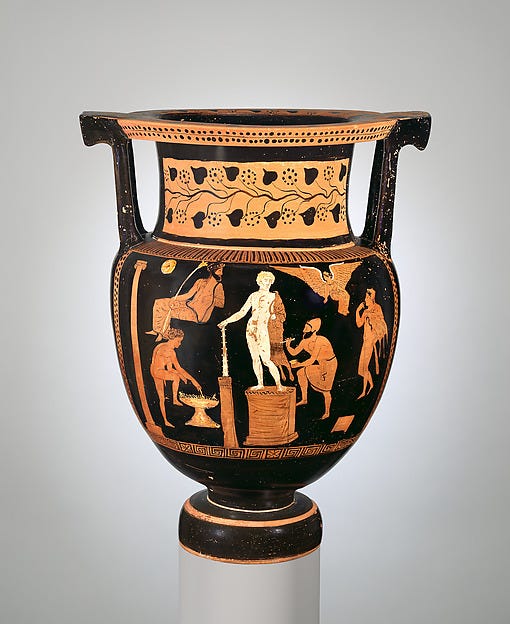
Terracotta column-krater, ca. 360-350 BCE. The scene shows an artist painting a statue of Herakles while Herakles himself approaches his image. Public Domain, The Metropolitan Museum of Art.
A maturing land project eventually has to develop a more precise vocabulary for the exchanges already taking place inside it.
In the beginning, this kind of precision can feel strangely hostile to the spirit of the place. Early communities often survive because people are willing to blur the difference between being invited in, helping out, being trusted, carrying responsibility, receiving care, and belonging. The blur feels generous because nobody has yet demanded that every gesture become a contract. It lets the project remain warmer and more alive than the institutions many people came there to escape.
But the blur does not remain innocent for long.
Every living project runs through exchange, and a regenerative one may rightly want forms of exchange that are subtler than wages, rent, and job titles. The community may continue to speak in the language of trust, but its real economy starts to move through things that have no clear price and no agreed meaning. Beauty cannot stabilize that forever. Neither can sincerity.
01 / The Shadow Economy
This is where informal communities often develop a shadow economy of interpretation. When conventional markers of status are softened or hidden, social capital does not disappear. It becomes more secluded. The founder’s delayed reply after a disagreement begins to feel like information.
Small communities can become politically dense very quickly for this reason. A land project may contain only twenty people and still produce a hundred group chats, because formal structure has not removed politics. It has simply pushed politics into smaller channels. By the time everyone sits in the circle to speak openly, much of the interpretation may already have happened elsewhere.
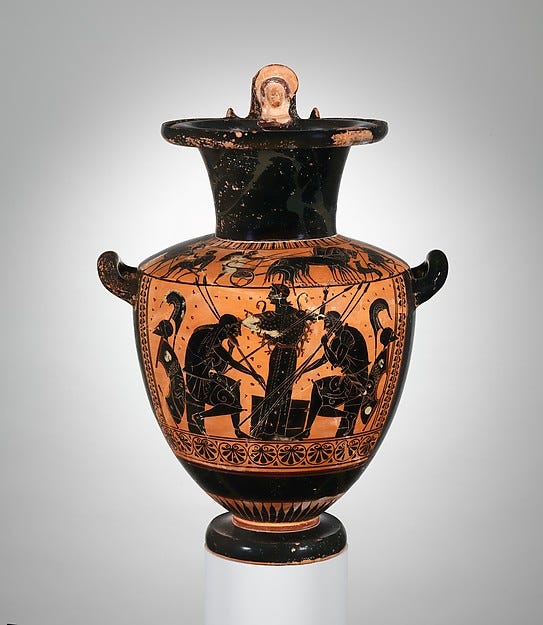
Terracotta hydria, ca. 510 BCE. Achilles and Ajax play a board game at Troy, with Athena placed between them. Public Domain, The Metropolitan Museum of Art.
02 / Politics In The Kitchen
Politics does not stay outside a community because the community has a beautiful manifesto. It follows people into the kitchen, the garden, the shared car, the dinner table, the volunteer schedule, and the ordinary social weather through which people become close to power.
A regenerative project can reject capitalist status symbols and still build another status system. It can reject hierarchy as an ideology while reproducing hierarchy through the ability to define what counts as alignment.
This is why communication practices alone cannot carry the weight of real conflict. A group circle, a bonfire conversation, therapy language, Nonviolent Communication, or a tea-model exchange may help people slow down enough to hear one another. These methods can give people a way to speak when direct confrontation would otherwise become too harsh.
But they are not a substitute for governance, especially when the conflict is not only about feeling unheard.
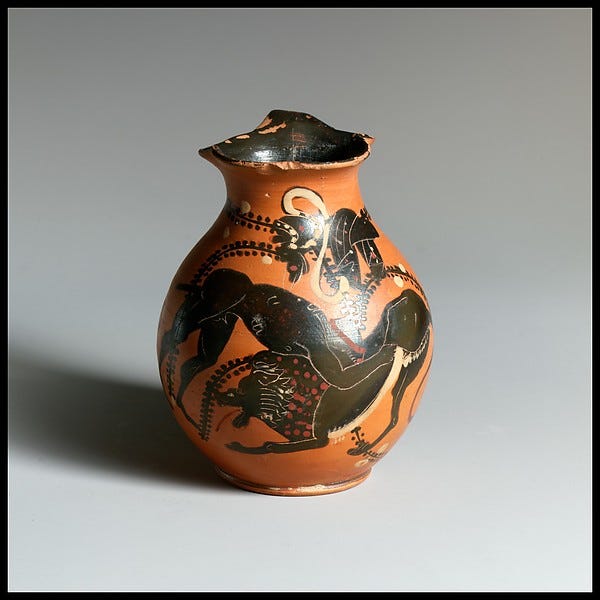
Terracotta oinochoe, early 5th century BCE. Herakles wrestles the Nemean lion, one of the labors that later made him legible as a hero. Public Domain, The Metropolitan Museum of Art.
03 / When The Circle Is Not Governance
Many of these methods come from the psychological and professional culture of modern urban life. They assume a person who can enter a difficult conversation, name an emotion, make a request, and then return to a separate structure of personal space.
In a regenerative project, conflict may pass through where a person sleeps, whether they can remain in the community, how guests are protected, how money is handled, how close one is to the founder, and whether future opportunity is still being quietly promised.
People do not simply leave the session and go home. They continue meeting one another in the same kitchen, under the same roofline.
A council circle that belongs to a living tradition is not merely a seating arrangement or a tone of voice. It is carried by a larger grammar of memory, authority, responsibility, consequence, and repair.
When retreat culture borrows the shape of the circle and fills it with therapeutic language from the city, it may create a powerful atmosphere of sincerity without creating the deeper conditions that make sincerity politically reliable.
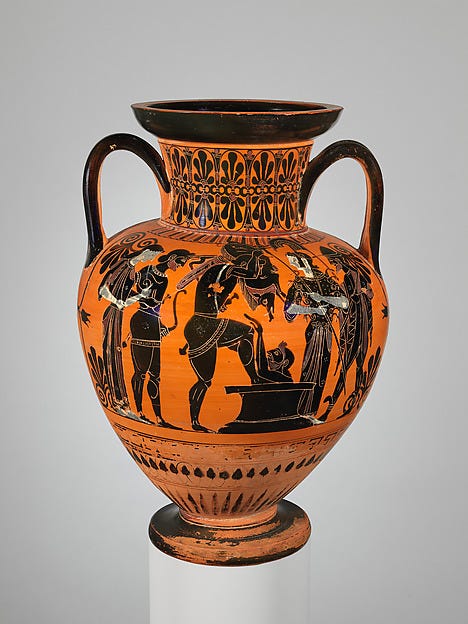
Terracotta neck-amphora, ca. 520 BCE. One side shows Ajax carrying the body of Achilles; another shows Herakles bringing the Erymanthian Boar to King Eurystheus. Public Domain, The Metropolitan Museum of Art.
04 / Naming As Maintenance
The community needs more accurate language.
A conflict about labor cannot be resolved only by asking people to speak with more compassion. This is where naming becomes a serious practice. A maturing land project needs its own grammar and dictionary, not as branding language, but as a way to survive change.
This is also where storytelling becomes a serious practice. A community is held together by the work it assigns and by the way that work becomes remembered: who made a mistake that changed the rule, who carried a burden before anyone recognized it, and who left behind a form of care that later people could name.
To make narrative part of maintenance is not to romanticize labor. It is to let ordinary life count as history.
Human beings do not learn belonging through instruction alone. They learn through stories that tell them what kind of life they have entered and what kind of person they may become inside it.
A community that refuses to tell its own stories leaves its members trapped in atmosphere, guessing what matters and what will be forgotten. A community that remembers well gives people a different dignity.
The chore chart is not only a list of duties. It is also a record of what the place is willing to name. Who carried the invisible work? Who noticed the pattern? Who repaired the system without turning themselves into a martyr? Who became heroic only because somebody later understood the labor correctly?
The only real exchange between communities happens at the level of mythology. The exchange is empty if it only takes the outer method. What meets another culture is a story of how life is understood. For a contemporary community to learn honestly, it has to bring its own emerging history into the exchange.
Part four asks what happens when that story is tested by popularity, money, material wealth, or disaster.
Commonwealth archive version and markdown mirror: https://commonwealth.la/field-notes/does-story-making-put-the-heros-name-on-the-chore-chart/
Image sources: The Metropolitan Museum of Art Open Access collection objects 254649, 254887, 247235, and 254878.